Guardians of the Earth: How Muslim Americans Are Answering Faith's Call to Climate Action
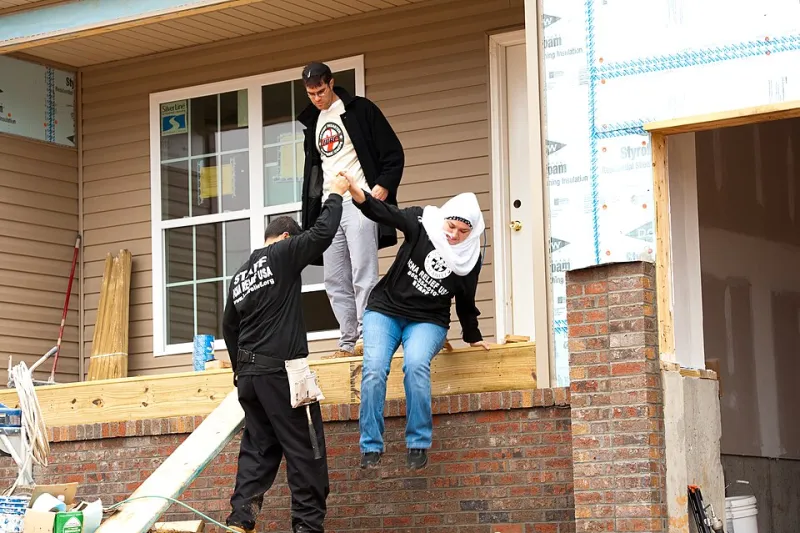
Photo: Department of Homeland Security. Federal Emergency Management Agency. Public Affairs Division. 3/1/2003, Public domain, via Wikimedia Commons
In the summer of 2022, a coalition of Muslim community leaders in Detroit gathered not for Friday prayer, but to plant trees. The initiative, organized through a local mosque in partnership with a regional environmental nonprofit, was modest in scale — a few dozen volunteers, a handful of saplings, a single afternoon. Yet for those present, the act carried a weight that extended far beyond horticulture. It was, as one organizer described it, an act of worship.
"We are not just fixing a neighborhood," said Imam Khalid Hamdan, who helped lead the event. "We are fulfilling an obligation that Allah placed on us before we were born."
This sense of sacred obligation is driving a quiet but consequential movement among Muslim Americans — one that connects ancient theological principles to some of the most urgent environmental challenges of the twenty-first century.
The Quranic Foundation for Environmental Ethics
At the heart of Islamic environmental thought lies a single, layered word: khalifah. Translated variously as steward, trustee, or vicegerent, the term appears in the second chapter of the Quran, where Allah declares that humanity has been appointed as a caretaker of the Earth. It is not a title of dominion, scholars emphasize, but one of responsibility — a covenant between the Creator and creation.
Companion concepts reinforce this framework. Mizan, the principle of balance and proportion woven into the natural order, calls on believers not to disrupt what Allah has set in equilibrium. Fasad, meaning corruption or destruction, is explicitly condemned in the Quran as a moral failure. Taken together, these teachings form what many Muslim environmental thinkers describe as a comprehensive ecological ethic — one that predates the modern environmental movement by more than a millennium.
"The Islamic tradition has always understood the environment as an amanah — a trust," said Dr. Aminah Rashid, a scholar of Islamic jurisprudence at a mid-Atlantic university who has written extensively on eco-theology. "What is new is that American Muslims are finally mobilizing around that trust in organized, public ways."
Organizations on the Front Lines
Perhaps no institution has done more to formalize this mobilization than the Green Muslims organization, based in Washington, D.C. Founded in 2009, Green Muslims has spent more than a decade building a bridge between Islamic faith and environmental activism, hosting educational workshops, leading community cleanups, and developing curricula for Islamic schools and Sunday programs.
The organization's work has taken on new urgency in recent years. As climate-related disasters — floods, wildfires, extreme heat — disproportionately affect low-income and minority communities, Green Muslims has increasingly framed environmental advocacy as an extension of social justice. "Climate change is not an abstract threat," said one of the organization's program coordinators. "It is hitting our communities right now. And our faith demands that we respond."
Similar energy is evident in California, where the Islamic Networks Group has incorporated environmental justice into its broader community education mission, and in Chicago, where a network of South Side mosques has partnered with local urban farming initiatives to address food security in underserved neighborhoods. In Houston — a city that has experienced repeated catastrophic flooding — Muslim community centers have become hubs for disaster preparedness and climate resilience planning, drawing on both faith-based motivation and practical necessity.
Youth at the Vanguard
If institutions are laying the groundwork, it is young Muslim Americans who are injecting the movement with its most visible momentum. A generation that came of age alongside the climate strikes of the late 2010s and the expanding discourse around environmental racism is finding in Islam a framework that validates and amplifies their concerns.
Nadia Osman, a twenty-four-year-old environmental studies graduate from New Jersey, co-founded a campus Muslim environmental group during her undergraduate years that has since expanded to several universities. "I grew up hearing that being Muslim meant caring for others," she said. "At some point I realized that 'others' has to include the planet."
Osman's group, like many of its peers, intentionally connects Islamic vocabulary to contemporary climate language. Lectures pair Quranic verses with data on carbon emissions. Ramadan initiatives encourage participants to reduce food waste as an act of gratitude — shukr — for divine provision. Eid celebrations are organized with an eye toward minimizing single-use plastics.
The effect, participants say, is not merely practical but spiritual. "When you understand why you're doing something — when it's connected to your deen — it changes how seriously you take it," Osman explained.
Mosques as Green Institutions
Beyond activism, a number of American mosques are undertaking structural transformations to align their physical operations with Islamic environmental values. The Islamic Society of North America (ISNA) has actively promoted mosque greening through its environmental initiative, encouraging congregations to install solar panels, adopt energy-efficient lighting, and implement water conservation measures.
In 2015, ISNA joined more than 60,000 Muslim leaders worldwide in signing the Islamic Declaration on Global Climate Change, a landmark document that called on Muslim-majority nations and communities to phase out fossil fuels and commit to 100 percent renewable energy. While the declaration's direct policy impact has been limited, it has served as a powerful symbolic statement — and a reference point for American Muslim communities seeking theological grounding for their environmental commitments.
Some congregations have gone further still. A mosque in suburban Maryland recently completed a full solar installation, covering a significant portion of its energy needs and reducing its carbon footprint substantially. The project was framed to the congregation not as an economic decision — though the long-term savings are real — but as a fulfillment of Islamic stewardship principles. "We wanted our building to reflect our beliefs," said the mosque's facilities director.
The Intersection of Faith and Justice
For many Muslim environmental advocates, the movement cannot be separated from broader conversations about racial and economic justice. Communities of color — including many Muslim American communities concentrated in urban centers — often bear the heaviest burden of environmental degradation, from air pollution to flooding to heat islands. Framing climate action through the lens of adl (justice), a foundational Islamic value, allows advocates to speak simultaneously to faith, community welfare, and systemic inequality.
"Environmental justice is Islamic justice," said Imam Dawud Walid, a prominent Muslim leader and advocate based in Michigan. "When we talk about polluted water in a poor neighborhood, or families displaced by a hurricane that climate change made worse, we are talking about dhulm — oppression. And Islam has never been silent about oppression."
This integrated vision — of faith, community, and ecological responsibility as inseparable — may be the most distinctive contribution of the American Muslim environmental movement. It offers neither a purely secular environmentalism nor a narrowly devotional piety, but something more holistic: a tradition insisting that caring for the Earth is, at its root, an act of caring for humanity and honoring the divine.
As the saplings planted in Detroit take root, and as more mosques, campuses, and community organizations across the country answer this call, that tradition is finding new expression in American soil.